The SKA is coming to life as it passes early science tests

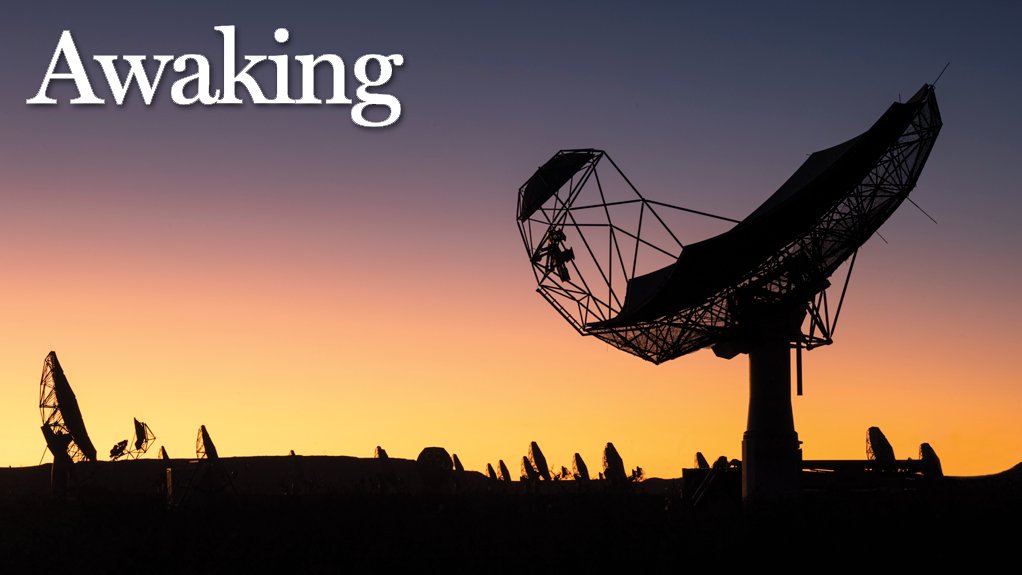



This month saw the achievement of another milestone for the international Square Kilometre Array (SKA) radio telescope programme, which is being developed by the UK-based SKA Observatory (SKAO) and is composed of two instruments, based in South Africa and Australia.
The milestone was reached by the SKA-Mid instrument, being developed in the Karoo region of South Africa’s Northern Cape province, and involved two of the SKA-Mid’s dishes working together as an interferometer for the first time.
“This is the first true test that all our systems are working together, and that the SKA-Mid telescope is alive as a scientific instrument,” highlights SKAO director-general Professor Philip Diamond.
“Having each dish observe the sky individually is an achievement, but having them operate in concert as one telescope is a much bigger technical challenge, and our teams have now achieved that milestone.”
Interferometry involves pointing two or more radio telescope antennas on the same object in the sky at the same time and then combining the data they receive, creating the effect of an observation by a much larger single telescope. When data is successfully combined, the result is known as “fringes”. This test of the SKA-Mid thus achieved “first fringes”. The target (or “source”) for this test was a radio galaxy located some 2.6-billion light years from Earth.
“This source has been well studied, so we know what the signal should look like, and that’s what we observed with this ‘first fringes’ result,” reports SKA-Mid commissioning scientist Dr Betsey Adams.
“It confirms that all our hardware and software systems are working as we designed them to do, giving us confidence as we begin to commission the telescope. That includes seeing that the dishes can track across the sky in a coordinated way under the control of the telescope manager software, the receivers are being cooled to the required temperature of –250 °C, the synchronisation and timing system is accurately timing signals from the different dishes to a billionth of a second, and the correlator is correctly processing and aligning the data.”
“Starting the year with this news is a huge boost for the teams that have worked extremely hard to see it happen, including SKAO and [South African Radio Astronomy Observatory] colleagues, and our global and local partners who are contributing to the infrastructure, hardware and software for SKA-Mid,” enthuses SKA-Mid senior project manager Ben Lewis.
“With all we’ve learned from these months building up to first fringes, we’re in a strong position to achieve our next milestone – the first image from a four-dish array within the next few months – and then see SKA-Mid gradually grow in size and capabilities from there.”
To date, seven SKA-Mid dishes have been assembled. Twelve more are in the process of being delivered from their manufacturer, CETC54, in China. Each SKA-Mid dish has a diameter of 15 m, each is composed of 66 panels, and each of these panels has its own specific curvature, depending on its location on the surface of the dish. To guarantee a smooth collecting surface, the dish panels must be adjusted with extreme accuracy – the average accuracy being between 0.01 mm and 0.03 mm, or less than the width of a human hair.
The SKA-Mid is so-called because it covers the middle of the radio frequency range, specifically from 350 MHz to 15.4 GHz. (The ultimate goal is to reach 24 GHz.) Each dish will initially be fitted with four receivers, each covering a different segment of this frequency range. (When funds permit, an extra two receivers will be fitted to each dish, to close gaps in the frequency coverage.) While the dishes come from China, the receivers (which are also known as “feeds”) have been developed in South Africa, Germany and Sweden.
When completed, Phase 1 of the SKA-Mid will comprise 133 of the 15 m dishes, plus 64 of MeerKat’s 13.5 m diameter dishes (the plan being to integrate MeerKAT into the SKA-Mid). All the dishes are connected by optical fibre, so that they can be directed to act as if they were a single telescope. The dishes will be grouped into a central core, about one kilometre in diameter, and spiral arms radiating out from it. The two furthest dishes will be 150 km apart. The result will be a total collecting area of 33 000 m2. The design of the SKA-Mid involved contributions by institutions in Australia, Canada, China, France, Germany, Italy, Spain, Sweden and the UK, as well as, of course, South Africa. The instrument is being assembled using components from all around the world, including South Africa.
Each dish is composed of a main reflector (the 15 m surface), a sub-reflector (mounted on a framework in front, and offset towards the bottom, of the main reflector), and the receivers (mounted on a structure known as the feed indexer). The main reflector catches the radio waves and reflects and focuses them on to the sub-reflector, which then directs them to the receivers. The receivers convert the radio waves from analogue to digital, allowing the signals to be processed. Signals are boosted by means of a low-noise amplifier and sent along optical fibre to processing facilities, which are off-site.
The Observatory
The SKAO is an intergovernmental organisation, with its head office at one of the world’s most famous radio astronomy sites, Jodrell Bank, in England. It legally came into being in December 2020 and its current member countries are Australia, Canada, China, Germany, India, Italy, the Netherlands, Portugal, South Africa, Spain, Sweden, Switzerland and the UK. The SKAO was preceded by the SKA Organisation, a private institution created in November 2011 and initially based at the University of Manchester, before it moved to Jodrell Bank. That, in turn, was preceded by a small SKA office, also at Manchester.
However, the idea for the SKA went back to the late 1980s. Radio astronomers from around the world wanted to be able to study the “Cosmic Dawn”, the period from about 100-million years to one billion years after the Big Bang, which saw the emergence of the first stars and the first galaxies, to help answer some of the fundamental questions about the universe. Studies showed that to do this would require a collecting surface equivalent to one square kilometre (or 1 000 000 m2).
The development of the SKA concept was marked by the design, construction and very successful operation of two precursor radio telescope arrays – South Africa’s MeerKAT, and Australia’s ASKAP (which stands for Australian SKA Pathfinder). These two instruments were developed by the two countries themselves, not by the then SKA Organisation, as national capability and technology demonstrators, as well as fully functional radio telescope arrays. Unlike MeerKAT, ASKAP (which is composed of 36 parabolic dishes, each with a diameter of 12 m) will not ultimately be incorporated into the SKA.
In addition to its obvious scientific objectives and impacts, the SKAO is also very aware of its role in developing technology and engineering, stimulating manufacturing and creating jobs, in its member countries and those countries intending to become members.
Further, it is committed to ensuring that the entire programme is and will be sustainable, with sustainability defined as a “foundational value” of the SKAO. There are five priorities under this rubric – science, social equity, environment, education and opportunities, and radio spectrum.
Science sustainability takes the form of a commitment to Open Science, that is, to scientific research that is transparent, collaborative and accessible to all, as well as to the FAIR (findability, accessibility, interoperability and reusability) principles for scientific data.
Social equity means ensuring a diversity of life experiences, backgrounds and nationalities among its staff, at its events, and in its communications, as well as ensuring gender balance. It also means fair outcomes for all, and for all its stakeholder communities.
Regarding environmental sustainability, the SKAO is and will measure, monitor and minimise its environmental footprint, including ensuring resource conservation, waste minimalisation, maximising the use of renewable energy, and, during construction, minimising the use of potable water. It should be noted that the site for the SKA- Mid (and the MeerKAT) is now a national park – the MeerKAT National Park – which has an area of 135 000 ha.
Sustainability in education and opportunities involves supporting and stimulating science, technology, engineering and mathematics education and training. This is being done in cooperation with local organisations and through public engagement activities.
As for radio spectrum sustainability, this means working to retain access to the radio spectrum for radio astronomy (as well as other purposes). While both the SKA-Mid and SKA-Low are located in radio quiet areas, they can be affected by overflying aircraft and especially low Earth orbit satellite constellations. The SKAO is a founder member of the international Centre for the Protection of the Dark and Quiet Sky from Satellite Constellation Interference. Further, last month, the SKAO co-hosted (with the UN Office of Outer Space Affairs) a Workshop on Dark and Quiet Skies for Science and Society, which was attended by more than 200 representatives involved in science, policy and the satellite industry, from 86 countries, from all the inhabited continents, to minimise the impact of satellite constellations.
Antenna Forests
The SKA-Low is located in the Shire of Murchison, on the traditional lands of the Wajarri Yamaji people, in the state of Western Australia, and is a very different instrument to the SKA-Mid. Instead of dishes, the SKA-Low will, when finished, comprise 131 072 fixed log-periodic “wire” antennas, each 2 m tall, and each looking rather like an abstracted metal Christmas tree. Attached to the “trunk” of each antenna are pairs of dipoles, like branches, with the longest at the bottom, steadily decreasing in length until the shortest forms the top. The different lengths of dipole absorb different radio wavelengths; the longer the dipoles, the longer the wavelength that they absorb.
These antennas will be grouped into 512 “stations”, each of 256 antennas. These will also be arranged in a central core – only 1 km across – and along three spiral arms radiating out from it. The distance between the two furthest stations will be 74 km. Reportedly, by the end of last year/start of this year, some 15 000 antennas had been erected in about 70 stations. Institutions in China, Italy, Malta, the Netherlands and the UK, as well as in Australia, contributed to the design of the SKA-Low.
The SKA-Low covers the frequency range from 50 MHz to 350 MHz, and works in a very different way to the SKA-Mid. While the SKA-Mid dishes are pointed at an object or phenomenon, the fixed antennas see the whole sky, all the time.
The SKA-Low operates by filtering out everything that the astronomers do not desire to observe. When radio waves from space hit the dipoles, they excite them and in so doing generate an electrical current. These currents are collected through a central transmission line and transmitted to the top of the antenna, where two low-noise amplifiers boost the signal, which is then sent to a smartbox (each station has one), which converts the electrical signals into optical ones and sends them down optical fibres to the Central Processing Facility (CPF).
At the CPF, the signals undergo a lot of processing to “clean” and digitise them. Then they are sent to an off-site processing centre (in Perth). There, the telescope’s correlator and the array-beamformer combine the signals from the multiple stations. This process allows astronomers to focus on the specific phenomenon or phenomena that they wish to study – it can be thought of as “digitally pointing” the instrument in one or multiple directions.
The SKA-Low achieved its first image last year. This was obtained by 1 024 antennas in four stations, amounting to less than 1% of the size the array will be, when it is finished.
Article Enquiry
Email Article
Save Article
Feedback
To advertise email advertising@creamermedia.co.za or click here
Research Reports


Projects


Latest Multimedia

Latest News

Showroom

Sulzer South Africa, established in 1922, partners with critical industries like power, oil & gas, water, mining, and chemicals to boost...
VISIT SHOWROOM
Industrial Nozzles & Systems (Pty) Ltd (Est. 2000) exclusive representative in Southern Africa for LECHLER GmbH (Est. 1879) - Europe's leading...
VISIT SHOWROOM



Press Office
Announcements
What's On
Subscribe to improve your user experience...
Option 1 (equivalent of R125 a month):
Receive a weekly copy of Creamer Media's Engineering News & Mining Weekly magazine
(print copy for those in South Africa and e-magazine for those outside of South Africa)
Receive daily email newsletters
Access to full search results
Access archive of magazine back copies
Access to Projects in Progress
Access to ONE Research Report of your choice in PDF format
Option 2 (equivalent of R375 a month):
All benefits from Option 1
PLUS
Access to Creamer Media's Research Channel Africa for ALL Research Reports, in PDF format, on various industrial and mining sectors
including Electricity; Water; Energy Transition; Hydrogen; Roads, Rail and Ports; Coal; Gold; Platinum; Battery Metals; etc.
Already a subscriber?
Forgotten your password?
Receive weekly copy of Creamer Media's Engineering News & Mining Weekly magazine (print copy for those in South Africa and e-magazine for those outside of South Africa)
➕
Recieve daily email newsletters
➕
Access to full search results
➕
Access archive of magazine back copies
➕
Access to Projects in Progress
➕
Access to ONE Research Report of your choice in PDF format
RESEARCH CHANNEL AFRICA
R4500 (equivalent of R375 a month)
SUBSCRIBEAll benefits from Option 1
➕
Access to Creamer Media's Research Channel Africa for ALL Research Reports on various industrial and mining sectors, in PDF format, including on:
Electricity
➕
Water
➕
Energy Transition
➕
Hydrogen
➕
Roads, Rail and Ports
➕
Coal
➕
Gold
➕
Platinum
➕
Battery Metals
➕
etc.
Receive all benefits from Option 1 or Option 2 delivered to numerous people at your company
➕
Multiple User names and Passwords for simultaneous log-ins
➕
Intranet integration access to all in your organisation